
US Wheel Adapters Guides | What is my bolt Pattern?
*We highly recommend first looking at our Vehicle Bolt Patterns & Spec Sheet before trying to measure manually. Secondly, we recommend Your local wheel and tire shop for measuring bolt patterns (PCD) as there are MANY similar patterns that can’t be differentiated with a tape. With that being said…
Measuring a bolt pattern is straight forward with an even number of lugs such as 4, 6, or 8 lug. Simply Measure from one bolt / hole to the bolt / hole directly across from it. With a 5 lug pattern we must Measure from the Outside of Stud 1 to the Center of Stud 3.
4 Lug Bolt Pattern (4x)
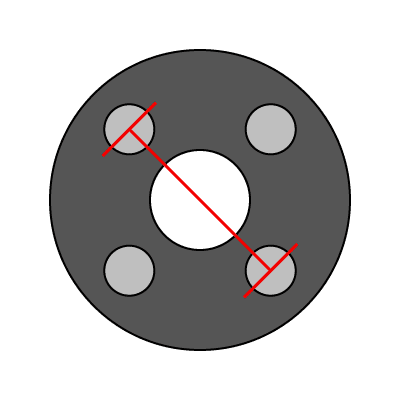
Measure from the center of one stud to the center of the stud directly across.
5 Lug Bolt Pattern (5x)
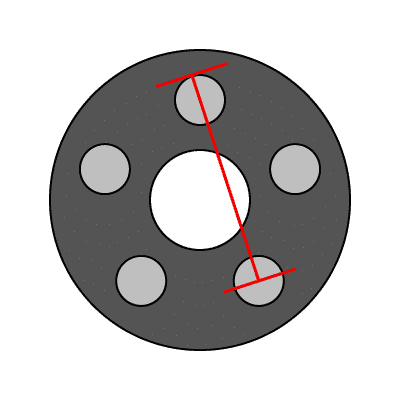
Measure from the OUTSIDE of stud 1, to the CENTER of stud 3.
6 Lug Bolt Pattern (6x)
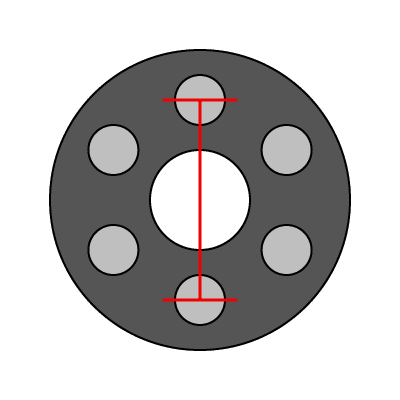
Measure from the center of one stud to the center of the stud directly across.
8 Lug Bolt Pattern (8x)
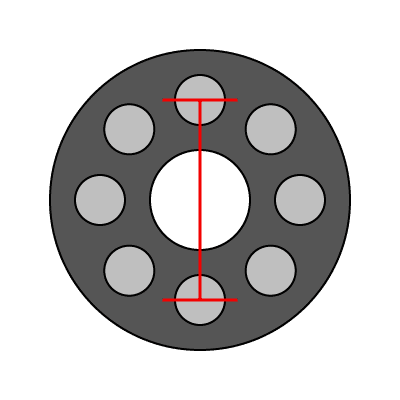
Measure from the center of one stud to the center of the stud directly across.

Custom Wheel Adapter Guide
Custom orders may be placed with our “Build to Make & Model” Pages by simply entering Year Make & Model for both the vehicle and wheel side.
Design & order wheel adpaters from the ground up on our “Build to Spec” Pages by selecting your lug count above, and following the steps below. These steps can also be used to order lug centric parts from our “Build to Spec” Pages. Simply exclude steps 3 and 6.
Vehicle Side | Build to Specs
- Vehicle Bolt Pattern. Enter vehicle bolt pattern first.
- Select Stud Size. This selection determines the installation lug nuts sent with the parts.
- Vehicle Hub Diameter. Enter the vehicle hub diameter here. This dimension should be sourced from the guide, OR measured with micrometers or calipers. These measurements need to be as accurate as possible. TAPE Measurements are NOT accurate enough to machine to.
- Wheel Bolt Pattern. Select the bolt pattern of the wheels to install.
Wheel Side | Build to Specs
5. Stud Size for wheel to accept. Pick the stud size you would like the wheels to fit onto. Most customers want the inside and outside hardware to match. This means that the Vehicle stud size & wheel stud size will match.
6. Center Bore diameter of wheel. Type out the diameter of the wheel center bore. This can be sourced from the wheel manufacturer, OR measured with calipers or micrometers. Local machine shops around you use these tools everyday. This means they can measure the center bore as well.
7. Thickness: Finally, select a thickness. The thinnest possible adapters we build for safety are 1″ thick. Adapters can be made thicker to account for offset. Thus, a thicker part will push the wheels out further. Thickness plays little to no part in strength or stability of adapters.
8.* When installing a bolt on wheel spacer or adapter, trimming the studs will be necessary when the spacer or adapter plate is thinner than your wheel studs are long.
How do I find my bolt Pattern(s)?
OEM bolt patterns are provided in our Bolt Pattern & Hub Guide. Manual measurements can also be used. Golf Cart, UTV & ATV Specs must be provided by customer.
Custom Wheel Spacer Guide
Custom wheel spacers may easily be ordered With our Year Make & Model order pages OR design & order wheel spacers from the ground up on our “build to Spec” pages. Start by selecting your lug count above These steps can also be used to order lug centric spacers from our “Build to Spec” Pages. Simply exclude steps 3 and 6.
Vehicle Side
- Vehicle Bolt Pattern. Enter vehicle bolt pattern first.
- Select Stud Size. This selection determines the lug nuts sent with the adapters.
- Vehicle Hub Diameter. Enter the vehicle hub diameter here. This dimension should be sourced from the guide, OR measured with micrometers or calipers. These measurements need to be as accurate as possible. TAPE Measurements are NOT accurate enough to machine to.
Wheel Side
4. Center Bore diameter of wheel. Type out the diameter of the wheel center bore, if it is not the OEM wheel. This can be sourced from the wheel manufacturer, OR measured with calipers or micrometers. Local machine shops around you use these tools everyday. This means they can measure center bores as well.
5. Thickness: Finally, select a thickness. The thinnest possible custom bolt-on spacers we build for safety are 1″ thick. The thinnest slip-on spacers start at 5mm thick. Spacers can be made thicker to account for offset. Thus, a thicker spacer will push the wheels out further. Thickness plays no part in strength or quality of wheel spacers.
6.** When installing bolt on wheel spacers or adapters, trimming the studs will be necessary when the spacer or adapter plate is thinner than your wheel studs are long.
How do I find my bolt Pattern(s)?
OEM bolt patterns are provided in our Bolt Pattern & Hub Guide. Manual measurements can also be used. Golf Cart, UTV & ATV Specs must be provided by customer.
How thin of a Spacer Can You Make? | Minimal Clearance – Hub Length
Hub centric Wheel spacers – Minimum thickness when using factory wheels = Hub Length +3mm.
This also applies IF center bore of the wheel is equal to or smaller than a factory wheel. eg (70.5mm hub 70.5mm wheel bore)(70.5mm hub 64.1 mm wheel bore)
Measure hub length to find minimum thickness. No Returns will be accepted due to failure to follow all minimal clearance checks.
The minimum thickness for slip on style hub centric spacers running factory wheels will be 3mm thicker than the vehicles hub stands tall. This is in order to clear the existing hub lip or ‘flange’ found at the center of the hub. The minimum thickness is 5mm for vehicles using aftermarket wheels with a larger center bore. This is because when the wheel bore is larger, the spacers are bored straight through, avoiding these clearance issues found when spacing factory wheels with a matching hub and wheel bore. Also Available as a flat spacer plate or with “no-lip” when minimal clearance does not allow a hub centric lip.
Custom Hub Rings
US Wheel Adapters is dedicated to providing an accurate and up-to-date Guide with hub diameters for most year, makes, and models.
Bolt Pattern & Hub Guide
Following this guide will help you find the right size that match your vehicle, and wheel. However, we custom build to order using American materials, machinery, and hardware. We guarantee craftsmanship and materials. Below you’ll find our custom selection and in stock pages. You may view our bolt pattern & hub guide below to find the dimensions that match your vehicle, and aftermarket rim.
Estimated Build Time is usually 3-5 Business Days. Rush processing available*
Stock Size Rings*
All Plastic Stock Size Rings are carried in-stock and ready to ship.
All Aluminum Stock Size Rings are built to order and are non-returnable.
Stock Size is only a reference to commonly bought sizes of rings.
What size hub centric rings do I need?
- There are two measurements needed to determine what size you need:
- Outer Diameter (OD of the ring)
=Center bore (CB) of your wheels - Inner Diameter (ID of the ring)
=Hub diameter of your vehicle
How do I find out the hub diameter of my vehicle?
- Use Bolt Pattern & Hub Centric Guide to find the year, make, and model of your vehicle.
- Measure using Digital Micrometer or Dial Caliper.
- Have vehicle hubs professionally measured by a local wheel and tire shop OR machine shop.
How do I find out the wheel center bore diameter?
- The original boxing will have center bore or hub bore specs
- Manufacturer websites will usually have specs
- The store the wheels were originally purchased from will have specs.
- Have rims professionally measured by a local machine shop.
- Measure manually using Digital Micrometer or Dial Caliper.
*All Rings are built with a .070″ Outer flange. Request custom flange, or no flange at checkout*
We strive to make ordering custom parts as straight forward as possible. If you have any questions please give us a call.
Are Wheel Spacers & Adapters Safe?
When manufactured to exact tolerances and installed correctly, high-quality wheel spacers and adapters are entirely safe for daily driving, heavy towing, and off-road applications. Safety in the automotive industry relies on precision engineering and strict adherence to structural installation procedures. To ensure your custom setup remains safe, reliable, and vibration-free for the life of the vehicle, you must follow these fundamental maintenance protocols:
Clean and Clear Mounting Surfaces: Before installing any spacer or adapter, all mating surfaces must be completely clean and free of debris. Use a wire brush to remove rust, corrosion, scale, or leftover dirt from both your vehicle’s factory hub face and the back mounting pad of the wheel. A perfectly flush metal-to-metal connection prevents clamping force variances and stops the hardware from backing out under load.
Re-Torque Process: Wheel hardware naturally seats and settles within the first few miles of driving. It is absolutely mandatory to pull your wheels off and re-torque the inner spacer/adapter lug nuts after the first 25 to 50 miles of installation. Always use a calibrated torque wrench to tighten the hardware to your vehicle manufacturer’s exact foot-pound (ft\lbs) (Found in install instructions) specifications in a star pattern. Never use an impact gun, as it can easily over-stretch studs or crack aluminum components.
General Routine Maintenance: Treat your adapters and spacers with the same care as your vehicle’s braking or suspension system. Visually inspect the hardware during every routine tire rotation or oil change. Check the stud threads for any stretching or stripping, look for uniform torque across all lugs, and verify that the hub-centric lip remains snug and free of cracks. Consistent, proactive maintenance completely eliminates component failure.
What Are Wheel Adapters?
Use our top quality adapters to change bolt patterns in order to properly fit (adapt) wheels from one vehicle to the hub of a different vehicle. eg “6×5″ to 6×5.5″ or “14×1.5 Studs to 1/2″ Studs”. These parts can also be used to adapt or fit aftermarket wheels meant for a different vehicle. Another common use would be adapting aftermarket or stock wheels to a trailer. For example Wrangler wheels to an M416 military trailer. These are available in hub centric and lug centric designs and always bolt on to the vehicle. We custom build using all American machinery, materials, and hardware.
If you are looking to only space the wheel out from the chassis. You will want to browse Wheel Spacers.
What is a Hub Centric Adapter?
Adapters that fit tight to the hub like a factory wheel are referred to as hub centric. This adapter will also feature a simulated hub pilot machined onto the face side that receives the wheel. This exact fitment guarantees the wheel centers and hub pilots making for a smooth ride guarantee and perfectly safe on road use. Most hub centric parts are custom built to order to an be an exact match to each customers unique dimensions. Build time on custom orders is between 5 – 7 business days on average, but can vary! Our team stocks many different 4, 5, 6, and 8 lug adapters in order to match an ever expanding world of vehicles. American built hub centric are the safest adapter / spacer type we offer.
What are Wheel Spacers?
Wheel spacers are a bolt-on or slip on CNC Machined aluminum disk that pushes the wheels away from the vehicle hub. This creates more clearance in order to install new wheels, suspension upgrades, and brake upgrades. Wheel Spacers are often used solely for aesthetics. For example – Giving a negative offset look to Factory wheels with a High Positive offset. This pushes the wheels further out from the vehicle providing a more aggressive stance. Spacers can be used in the same fashion to Correct Offset
Are Wheel Spacers safe?
Wheel Spacers are safe as long as they are installed properly. This means adhering to torque specs from the vehicle manufacturer, and our included torque specs. Hub Centric spacers are a “like factory” fit. This is the safest type of wheel spacer you can buy.
Types of Wheel Spacers
-Slip On Style Spacers
Slip on style spacers slide directly over your existing vehicle studs and do not feature studs pre-installed into the face side. Because they fit over your stock studs, it is critical to ensure you have enough remaining thread length past the spacer for a completely secure wheel installation; otherwise, you will need to install extended studs. A solid rule of thumb is to have at least 7 to 8 full turns on each lug nut before torquing to your vehicle’s factory specifications. We recommend visiting OnTrackPerformanceParts.com or SummitRacing.com for high-quality extended wheel studs. These simple slip-on options can also be manufactured with a hub-centric lip to pilot the wheels flawlessly. Hub-centric slip-on spacers are best utilized on cars. Have compatibility or measurement questions? Call the number below or Contact US.
-Bolt On Style Spacers
Bolt on style widen the stance on our cars, trucks, & SUVs with a spacer that bolts on to your vehicle just like a wheel does. This style will also have studs coming out of the face side that act as the new studs for your wheels. These spacers are also commonly used to fix large backspacing & clearance issues. Spacers will keep the same bolt pattern as the vehicle.
-Hub Centric Wheel Spacers
Our specialty. Simply put, “hub centric” means the spacer is engineered to center perfectly around the vehicle’s hub snout. Hub-centric spacers feature a precision-machined inner bore and a protruding outer pilot lip that mimics your factory hub setup. This exact male-to-female fitment guarantees that the wheels roll perfectly true to the axle, completely eliminating high-speed steering wheel vibrations and ensuring a smooth, 100% safe ride for demanding highway speeds, heavy towing, or long drives. This is the ultimate setup for truck, SUV, and performance vehicle builds.
-Lug Centric Wheel Spacers:
Lug-centric spacers center themselves exclusively by the clamping force of the tapered lug nuts as they are torqued down into the wheel’s lug seats. Because they lack a dedicated center hub pilot lip to support the weight of the vehicle, lug-centric setups provide less reliable centering and can frequently lead to minor vibration issues, especially at highway speeds. Please note that generic or poorly fitting lug-centric spacers cannot be safely converted into a hub-centric style using a basic hub ring without custom machine modifications. If you are looking to change your bolt pattern you are looking for a Wheel Adapter—Wheel Adapters are found here.
What are hub centric rings used for?
- Hub rings fill the gap between the vehicle hub and the wheel bore. Centering rings eliminate vibrations caused by oversized wheel bores, or center bore. Wheel manufacturers commonly make wheels with oversized center bores allowing it to fit multiple vehicles. US Wheel Adapters machines parts from plastic and aluminum.
Why are Centric Rings so Important?
- Today’s suspensions are more intricate and sensitive, thus they are more sensitive to wheel / balance issues.
- Aftermarket wheels without rings are the most common cause of vibration issues.
- Rings guarantee the wheels are truly centered.
- Without the use of rings vibrations can eventually loosen or back-out lug nuts as a vehicle is driven.
*All Rings are built with a .070″ Outer flange. Request custom flange, or no flange at checkout*
We strive to make ordering custom parts as straight forward as possible.
What Material are hub rings made from?
Stock Plastic Rings
“In-Stock” Hub Rings are made from a mold injected plastic and are ready to ship! If you can’t find the exact rings that match your car or truck we can make them!
Custom Plastic Rings
Custom Plastic rings are made from High Density Polyethylene (HDPE). This is a hard, high heat resistant plastic. Stock size plastic rings eliminate vibrations caused by oversized wheel center bores. Meaning, they fill in the visible gap between your vehicle’s hub pilot, and the bore of aftermarket wheels.
Aluminum Rings
“Stock Size” and Custom Aluminum hub centric rings are made from an American t6061 Billet Aluminum. They are not carried in stock. These parts are all built to order via HAAS CNC Lathe and may take 2-3 business days to ship. Stock Size refers to the most popular sized rings ordered by customers over the years. There will be many more options of sizes available in aluminum vs plastic.
They also work to fill in the visible gap between your vehicle’s hub pilot, and the bore of aftermarket wheels.
What are wheel adapters and wheel spacers used for?
Our products fit a wide variety of applications, Therefore they can be used on cars, crossovers, race cars, imports, tuners, custom builds, street rods and muscle cars. While larger adapters and spacers are available to fit trucks, duallys, dually conversions (SWD to DWD & DWD to SWD) and Trailers. The hub centric builds are always the top recommendation. Also available for lawn mowers, tractors, side by sides, golf carts, ATVs UTVs, Trailers and more.
Adapters vs Spacers
The difference between an adapter and wheel spacer is simple. Adapters convert bolt patterns to fit different wheels Spacers will always keep the same bolt pattern. Adapters inevitably also space wheels further out from the vehicle while converting the bolt pattern.
Both products can be made to:
HUB CENTRIC – center on the hub or to center on the lugs – LUG CENTRIC – Center on the lugs
Hub Centric vs Lug Centric
Hub Centric wheel adapters and spacers, our specialty, are precision built to fit tight to the hub of the vehicle and pilot the wheels perfectly. This keeps everything rolling true to center, and avoids vibration issues. Hub centric is the strongest and safest setup anyone can have. The alternative is Lug Centric. Which, as the name suggests centers on the lugs which is less reliable for centering. The wheel’s center bore size is required for all hub centric builds! Browse our huge build to order inventory of US wheel adapters, spacers & hub rings above.
How to Shop Wheel Adapters & Spacers
In the world of adapters and spacers, the vehicle bolt pattern will be listed first. Both products are available in hub centric and lug centric designs. Wheel Spacers will list only the vehicle’s bolt pattern. All Custom adapters & spacers are manufactured using 6061 T6 Billet Aluminum. In-stock products ship same day if ordered before 2 PM Central Time. Shipped by USPS, allow 2-3 days for delivery. For overnight orders please call our experts at! You can browse our listed inventory above.
US Wheel Adapters vs Them
Our Custom Wheel Spacers and Adapters are made using all American HAAS machinery. We use 6061-T6 billet aluminum that is extruded and not cast forged. This makes for a stronger more uniform aluminum. Our studs are 10.9 grade hardness cold rolled. Hard and versatile (also US made). USWA also stocks lug centric and hub centric styles for many different vehicles and applications.
What about ATV Stuff?
Customers MUST provide measurements for Golf Carts, UTVs ATVs, and side by sides. We do not carry any info regarding these types of vehicles due to limited trustworthy sources.
Real World Uses
Marketplace Buys
Let’s say you purchase some 6 Lug Wheels that came off of a Chevrolet. The seller has stated “they will fit any 6 Lug Ford, Nissan, or Toyota.”
Turns out the seller (unknowingly) has misled you into buying wheels that won’t fit. Directly as least. Wheels purchased second hand via private sells on marketplace or online is the most common scenario we run into for needing to install adapters. This extends to fitting unique wheels only available to certain models of vehicle brands as well. Such as fitting new TRD wheels to Chevy, GMC, Ford, RAM. We also make custom parts at different thickness to help achieve the perfect stance.
Fleet Trucks
Wheel Adapters might also be used professionally by companies in operation of fleet vehicles of differing brands. If a company has a combination of Chevrolet & Ford Trucks in their fleet it would be much more convenient to be able to swap wheels between any vehicle at anytime. This is much more convenient in an emergency than being limited to swapping wheels between only one brand and model. With a hub centric, factory-like, fit this can be done with ease and safety.
Industry Specific Wheel Adapter Uses
We also build adapters to fit rail-wheels to different types of vehicles as well. This includes light pickups, heavy duty pickups, Custom electric rail cars, ATVs & UTVs. Travel by rail is reserved for Certified companies inspecting and repairing railway lines across the nation.